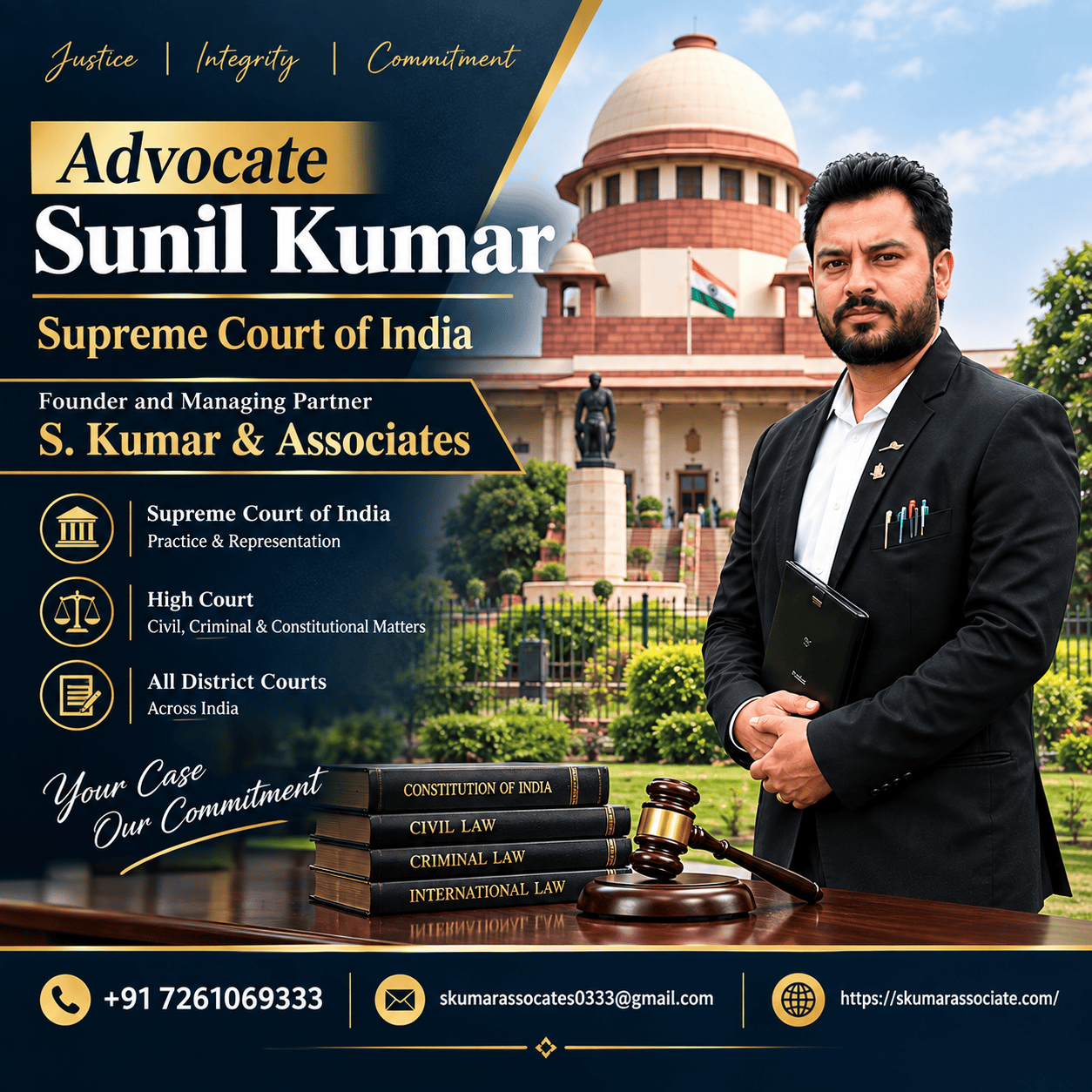
Advocate in Sector 33, Greater Noida for Industrial Property, Toy Park & YEIDA Legal Matters | Adv. Sunil Kumar (Helpline: +91 7261069333)
Legal Guidance for Industrial Property and Allotment Matters in Sector 33
Industrial property transactions often involve several legal and administrative requirements beyond the initial allotment or purchase. The terms of the scheme, payment obligations, eligibility conditions, lease documentation, site possession and permitted use may all influence an allottee's rights. A disagreement over any of these issues can affect the ability to develop a property, commence commercial operations or transfer the relevant rights.
Advocate Sunil Kumar, Supreme Court of India, High Court, Civil Court, Founder & Managing Partner of S. Kumar & Associates (Ph. +91 7261069333), provides legal assistance in property, civil, commercial, criminal, family and other litigation-related matters, subject to the facts of each case and the jurisdiction of the relevant court or authority. Industrial plot allottees, business owners, investors, property buyers and other clients dealing with matters concerning Sector 33, Greater Noida, can contact the firm to discuss documentation, allotment conditions, possession issues, lease-related concerns and potential legal remedies.
The legal approach should begin with a review of the original records, the sequence of events and the specific relief required. A dispute involving delayed possession may require a different response from one involving cancellation, unpaid instalments, transfer restrictions or an alleged breach of eligibility conditions. The appropriate course of action depends on the governing scheme, the documents, applicable law, limitation periods and any previous orders.
Sector 33 and the Toy Park: Understanding the Property Framework
YEIDA's official industrial-property information identifies the Toy Park in Sector 33 and publishes industrial-sector planning information and scheme records. The sector's property matters may therefore involve industrial allotment conditions, land-use restrictions, lease requirements and development-related obligations.
The precise position of an individual plot must be established through the relevant allotment documents and official records. The fact that a plot is situated in Sector 33 does not, by itself, establish that it belongs to a particular scheme or carries identical terms to every other plot.
Before purchasing, transferring or developing industrial property, examine:
The plot number, location, area and relevant site plan.
The allotment letter and the scheme brochure under which the plot was allotted.
Eligibility conditions and any restrictions on the allottee.
The payment schedule, receipts and outstanding-demand statements.
Conditions governing execution of the lease deed.
Physical possession records and site inspection documents.
Permitted industrial activity and applicable development conditions.
Any notices, cancellation proceedings or disputes recorded against the allotment.
The official YEIDA records should be checked for the particular scheme and plot. Archived brochures and older allotment lists may be useful for understanding historical conditions, but they should not be substituted for the documents and orders applicable to the individual property.
Industrial Plot Allotment and Eligibility Disputes
Industrial plot allotments may be made under different schemes, with eligibility and selection requirements that vary by plot category, size, and scheme conditions. A dispute may arise when an applicant challenges the allotment process, a successful applicant is asked to provide additional documents, or the authority alleges non-compliance with the scheme.
Legal review may be required where the issue concerns:
Eligibility of the applicant or business entity.
Incorrect or inconsistent information in an application.
Compliance with a one-allotment or related scheme restriction.
Disputed selection or allotment conditions.
A demand that differs from the terms of the applicable scheme.
Cancellation based on an alleged eligibility violation.
Refund conditions after cancellation or surrender.
A disagreement concerning the authority's interpretation of a scheme clause.
The original brochure is particularly important because it sets out the relevant requirements. A general description of an industrial scheme may not capture all the eligibility rules or exceptions.
If an allotment is challenged, the allottee should preserve the application, supporting declarations, company or partnership documents, allotment letter, payment records and correspondence with the authority. Any notice should be examined promptly to identify the response deadline and the available administrative or judicial remedy.
YEIDA Lease Deed and Possession Documentation
An allotment does not necessarily mean that every subsequent formal step has been completed. Depending on the scheme, the allottee may need to satisfy conditions before execution of a lease deed or delivery of possession.
A delay can become contentious when the allottee believes the necessary conditions have been fulfilled, but the authority has not completed the remaining formalities. Conversely, the authority may maintain that further payments, documents or compliance steps are required.
A useful legal review should establish:
What conditions the allotment letter and scheme impose.
Whether all required payments have been made or properly disputed.
Whether the authority has issued the relevant checklist or demand.
Whether the lease deed has been prepared, executed, or registered.
Whether physical possession has been offered and documented.
Whether any previous representation, settlement or court order affects the issue.
Whether a limitation period or procedural deadline applies.
Depending on the facts, a written representation, a request for a reasoned decision, a response to a demand or an appropriate legal proceeding may be considered. No remedy should be selected before determining the exact status of the allotment and the obligations of both parties.
Industrial Plot Possession and Infrastructure Concerns
Industrial allottees may face practical difficulties where the plot cannot be accessed easily, the boundaries are disputed, basic infrastructure is incomplete, or possession documents remain pending. These issues can become especially important when an allottee is asked to begin construction or comply with a development timeline.
A report published in August 2025 described complaints from industrial allottees in Sectors 32 and 33 concerning roads, power, water, drainage and pending possession-related documentation. The allottees and YEIDA expressed differing positions on the availability of infrastructure and the reasons for delays. The report concerned the issues raised at that time and does not establish the current status of every plot.
For an individual allottee, the key questions are whether possession has been formally offered, whether the plot is identifiable and accessible, whether any infrastructure commitment forms part of the relevant documents, and whether a construction deadline is legally enforceable in the circumstances.
Useful evidence may include:
The allotment and possession letters.
Site photographs and inspection reports.
The approved site plan and demarcation records.
Written requests for possession or infrastructure completion.
Replies received from the authority.
Notices requiring construction or compliance.
Any applicable extension, settlement or zero-period decision.
Previous court or authority orders.
A party should avoid assuming that infrastructure complaints automatically suspend every contractual deadline. The applicable scheme and any specific order must be examined to determine the legal position.
Industrial Plot Cancellation, Refund and Legal Remedies
Cancellation of an industrial plot allotment can have significant financial and commercial consequences. It may affect the amount already deposited, the allottee's ability to use the land and the possibility of securing another plot.
A report dated 29 April 2025 stated that YEIDA cancelled 16 industrial plot allotments after an inquiry into alleged irregularities in schemes relating to Sector 29's Industrial Park and Sector 33's Toy Park. The report described concerns about multiple allotments within the same family through separate entities and stated that the authority proposed refunds after a deduction. These were findings and actions relating to particular allotments; they do not establish that all allotments in Sector 33 were irregular.
Where an allotment cancellation is challenged, the relevant questions include whether the scheme restriction was clear, whether the facts support the alleged violation, whether the allottee received an opportunity to respond, and whether the authority followed the applicable procedure.
Depending on the case, legal work may involve examining the cancellation order, preparing a reasoned representation, challenging the decision before an appropriate forum or assessing a refund claim. The viability of any remedy depends on the original scheme terms, evidence and applicable law.
Property Due Diligence Before Buying or Transferring an Industrial Plot
A prospective purchaser should not rely exclusively on an allotment letter, a broker's statement or a payment receipt. Before committing funds, it is important to understand what rights the seller holds and whether those rights can lawfully be transferred.
A property review may involve the following:
Title and allotment: Confirm the identity of the recorded allottee or owner and review the original allotment, lease or conveyance documents.
Transfer restrictions: Check whether the scheme or lease requires prior permission, payment of transfer charges or compliance with other conditions.
Payment position: Obtain available statements and receipts and identify any unpaid instalments, interest, penalties or disputed demands.
Possession: Establish whether formal and physical possession has been delivered, and whether the plot boundaries match the available plans.
Permitted use: Check whether the intended activity is consistent with the applicable land-use conditions and required approvals.
Existing disputes: Review notices, cancellation proceedings, litigation and recorded encumbrances where information is available.
Transaction documents: Ensure that the proposed agreement accurately records the parties, property description, consideration, payment terms, conditions and consequences of default.
No document review can guarantee that undisclosed claims do not exist. The scope of due diligence should be tailored to the property, its legal status and the intended transaction.
Commercial Contracts and Business Disputes
Industrial property matters often overlap with business contracts. A dispute may involve a development agreement, a joint venture, a lease, a supply arrangement, unpaid invoices or disagreement about responsibility for project expenses.
The contract should be reviewed for the obligations of each party, performance deadlines, notice requirements, termination clauses, dispute-resolution provisions and any arbitration agreement.
A party considering legal action should organise the agreement, invoices, payment proof, correspondence and a dated chronology of the dispute. If the contract provides for arbitration, the clause and the applicable law should be assessed before selecting the next step.
Where recovery, injunction or another civil remedy is being considered, the appropriate forum and procedural requirements should be identified before proceedings are filed.
Civil Litigation and Legal Notices
Civil litigation may concern property rights, possession, contractual obligations, recovery of money, injunctions or challenges to administrative decisions. The relevant legal route depends on the nature of the dispute and the relief sought.
S. Kumar & Associates can discuss matters involving document review, legal notices, replies, representations, drafting and proceedings before a competent court or authority, subject to the scope of engagement and jurisdiction.
A legal notice should clearly state the material facts, identify the relevant grievance and set out the demand or response required. Unsupported allegations should be avoided, and all important communications should be preserved.
Receiving a notice does not mean that every allegation is established. However, a notice may contain a deadline or relate to an ongoing proceeding, so its contents should be examined promptly. A party should also consider whether a previous order or agreement affects the available options.
Hindi Legal Update: सेक्टर 33 में औद्योगिक प्लॉट के लिए क्या सावधानियां जरूरी हैं?
सेक्टर 33 के Toy Park और औद्योगिक प्लॉट से जुड़े मामलों में केवल अलॉटमेंट लेटर या भुगतान की रसीद देखना पर्याप्त नहीं है। योजना की शर्तें, पात्रता, लीज डीड, कब्जे के दस्तावेज और प्राधिकरण से हुआ पत्राचार भी महत्वपूर्ण हो सकता है।
29 अप्रैल 2025 की एक रिपोर्ट के अनुसार, YEIDA ने सेक्टर 29 के Industrial Park और सेक्टर 33 के Toy Park की कुछ औद्योगिक प्लॉट योजनाओं में कथित अनियमितताओं की जांच के बाद 16 आवंटन रद्द किए थे। रिपोर्ट में एक ही परिवार से जुड़े अलग-अलग संस्थानों के माध्यम से एक से अधिक आवंटन प्राप्त करने के आरोपों का उल्लेख था। यह कार्रवाई संबंधित आवंटनों तक सीमित थी; इससे यह निष्कर्ष नहीं निकलता कि सेक्टर 33 के सभी प्लॉटों में कोई अनियमितता है।
अगस्त 2025 की एक अन्य रिपोर्ट में सेक्टर 32 और 33 के कुछ औद्योगिक आवंटियों ने कब्जे के दस्तावेज और बुनियादी सुविधाओं को लेकर अपनी समस्याएं बताई थीं। प्राधिकरण ने सुविधाओं की स्थिति पर अलग पक्ष रखा था। इसलिए किसी विशेष प्लॉट की मौजूदा स्थिति जानने के लिए संबंधित रिकॉर्ड, निरीक्षण और आधिकारिक जवाब की जांच आवश्यक है।
व्यावहारिक सलाह: प्लॉट खरीदने या निर्माण शुरू करने से पहले मूल दस्तावेज, लीज की स्थिति, कब्जे का रिकॉर्ड, बकाया राशि और लागू शर्तों की जांच करें। यदि रद्दीकरण, नोटिस या कब्जे को लेकर विवाद है, तो समयसीमा और उपलब्ध कानूनी विकल्पों का आकलन कराएं।
Why Choose a Document-Based Legal Approach?
Industrial property disputes often involve a mixture of contractual, administrative and factual questions. A structured review can help identify the relevant obligations, missing records, disputed demands and procedural options.
Advocate Sunil Kumar's professional profile includes the Supreme Court of India, the Delhi High Court, and the Patna High Court. The appropriate court or authority for an individual dispute depends on jurisdiction, applicable procedure, and the nature of the relief sought.
The firm can discuss the available documents and the history of the matter before considering appropriate legal steps. No specific outcome can be guaranteed, and a legal strategy should be based on the individual case rather than assumptions drawn from unrelated disputes.
Frequently Asked Questions
1. Can I consult an advocate about a Sector 33 industrial plot?
Yes. You can contact the firm to discuss allotment conditions, cancellation, lease documentation, possession, title verification, or other civil and commercial property concerns. The relevant documents and jurisdiction should be reviewed first.
2. What should I do if my industrial plot allotment is cancelled?
Obtain the cancellation order, scheme brochure, allotment letter, payment records, and all related correspondence. The appropriate response or remedy depends on the reasons stated in the order, the scheme terms and the applicable procedure.
3. What if the lease deed or possession documents have not been issued?
Review the allotment conditions and confirm whether the required payments, documents, and other formalities have been completed. A written representation or other legal remedy may be considered depending on the record and applicable law.
4. Can I purchase a Toy Park or industrial plot from an existing allottee?
Before proceeding, verify the allottee's rights, transfer restrictions, required permissions, outstanding dues, lease status, and possession records. The proposed transaction should be reviewed according to the applicable scheme and original documents.
5. Does a dispute involving another Sector 33 plot automatically affect my property?
No. The effect of any order or dispute depends on the parties, facts, scheme, and legal reasoning involved. An individual allotment should be assessed separately unless a relevant order or legal rule applies more broadly.
6. What should I do if I receive a notice from YEIDA?
Read the notice carefully, note the response deadline, collect the supporting documents, and obtain advice on the relevant conditions and procedure. Do not assume that the notice is either automatically valid or legally ineffective without examining it.
7. How can I contact Advocate Sunil Kumar?
Call +91 7261069333 or visit https://skumarassociate.com/ to discuss your matter. Keep the allotment letter, lease deed, payment records, notices, and a short chronology ready for the initial discussion.
Contact S. Kumar & Associates
S. KUMAR & ASSOCIATES Advocates · Solicitors · Law Firm
Advocate Sunil Kumar Supreme Court of India · Delhi High Court · Patna High Court Founder & Managing Partner
Helpline: +91 7261069333 Email: [email protected] Website: https://skumarassociate.com/
For industrial allottees, businesses, investors and property buyers dealing with Sector 33, Greater Noida, the first step is to establish the legal status of the plot and organise the original records. A document-based review can help clarify the applicable requirements, potential risks and legal options available in the particular circumstances.
Legal Disclaimer
This page is provided for general legal information and educational purposes only. It does not constitute legal advice, a legal opinion on a specific matter, solicitation or a guarantee of any outcome. Legal rights and remedies depend on the facts, original documents, applicable law, limitation periods, jurisdiction and orders of the competent court or authority. Property information must be independently verified against original records and relevant official sources. Reading this page or contacting the firm does not, by itself, create an advocate-client relationship; any engagement is subject to appropriate professional arrangements and applicable rules.
🌍 IT NEWS — International Trending News
Breaking News | World Affairs | India | Technology | Business | Legal Updates | Fact-Check
Verified information. Responsible reporting. Global perspective.
Stay Informed. Stay Aware. Stay Ahead.
Advocate Sunil Kumar | Supreme Court of India
Founder & Managing Partner — S. Kumar & Associates
Legal consultation, litigation, legal research, case analysis, and legal awareness.
Helpline: +91 7261069333
Website: https://skumarassociate.com/
More Visit: https://advocatesunilkumarsupremecourtofindia.com/
YouTube: https://youtube.com/@advocatesunilkumarsc
📸 Photos & Videos